Pages

Showing posts with label Bull Power. Show all posts

Friday, October 9, 2015

Few Fast facts on Ban on Cow slaughter

Map of Indian States which Ban Cow Slaughter
  • Article 48 makes ban on cow slaughter one of Directive Principles of Indian Constitution adopted under Nehruvian Congress.
  • Ranbir Penal Code (RPC), an over 150-year-old law. Of J&K-Under section 298A of the RPC, intentionally killing or slaughtering a cow or like animal (including ox and buffalo) is a cognizable, non-bailable offence punishable with 10 years imprisonment and fine.
  • Likewise, under section 298B of RPC, possessing the flesh such an animal is a cognizable, non-bailable offence punishable with imprisonment of one year and fine. It is noteworthy that the RPC was enacted in 1862 by the then Dogra Maharaja of the state and is still Law.
  • Ranjit Singh, founder of the Sikh Empire and Maharaja from 1801 to 1839, banned cow slaughter throughout his domains.
  • Cow slaughter and beef eating habits started in India with the arrival of Islam but Arab countries never ate beef as there were no cows there then.
  • The Mughal emperor Babar ruled in 1526 that killing cows was forbidden.
  • Later Mughal emperors Akbar (reign: 1556 – 1605), Jahangir (1605 – 1627), and Ahmad Shah (1748 – 1754) imposed selective restricted bans on cow slaughter.
  • The last Mughal emperor Bahadur Shah Zafar banned Cow slaughter totally in 1857 .
  • It was Tyrant Aurangzeb who allowed Cow slaughter who wished to convert India into a Muslim country and then Britishers propagated it.
  • Cow and Calf meat export is totally banned in India as in “Beef export”
  • And stop equating Cow meat as your right to eat any meat and if you still insist then start with dogs.
  • And with all that stupid argument of evidence of meat eaters in Vedas , I will write another article on that ,, but that meat did not definitely mean Cow meat.
  • Last but not Least Cow Rearing and worship is not only associated with Sanatan Way of life but also to Rural Economy and well being of Locals .

Tuesday, September 13, 2011

Back to Bull Power -On Small Farms, Hoof Power Returns

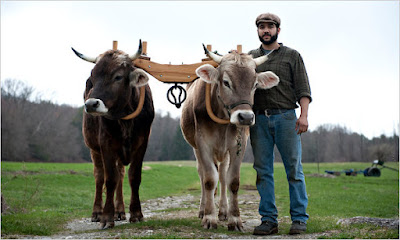
High fuel costs have some farmers returning to animal labor to help with farming, trading tractors for oxen

CourtesyNew York Times - May 2011

ON a sunny Sunday just before the vernal equinox, Rich Ciotola set out to clear a pasture strewn with fallen wood. The just-thawed field was spongy, with grass sprouting under tangled branches. Late March and early April are farm-prep time here in the Berkshires, time to gear up for the growing season. But while many farms were oiling and gassing up tractors, Mr. Ciotola was setting out to prepare a pasture using a tool so old it seems almost revolutionary: a team of oxen.

Standing just inside the paddock at Moon in the Pond Farm, where he works, he put a rope around Lucas and Larson, his pair of Brown Swiss steer. He led them to the 20-pound maple yoke he had bought secondhand from another ox farmer, hoisted it over their necks and led them trundling through the fence so they could begin hauling fallen logs.

Mr. Ciotola, 32, is one of a number of small farmers who are turning — or rather returning — to animal labor to help with farming. Before the humble ox was relegated to the role of historical re-enactor, driven by men in period garb for child-friendly festivals like pioneer days, it was a central beast of burden. After the Civil War, many farms switched from oxen to horses. Although Amish and Mennonite communities continue to use horses, by World War II most draft animals had been supplanted by machines that allowed for ever-faster production on bigger fields.

Now, as diesel prices skyrocket, some farmers who have rejected many of the past century’s advances in agriculture have found a renewed logic in draft power. Partisans argue that animals can be cheaper to board and feed than any tractor. They also run on the ultimate renewable resource: grass.

“Ox don’t need spare parts, and they don’t run on fossil fuels,” Mr. Ciotola said.

Animals are literally lighter on the land than machines.

“A tractor would have left ruts a foot deep in this road,” Mr. Ciotola noted.

In contrast, oxen or horses aerate the soil with their hooves as they go, preserving its fertile microbial layers. And as an added benefit, animals leave behind free fertilizer.

David Fisher, whose Natural Roots Community Supported Agriculture program in Conway, Mass., sells vegetables grown exclusively with horsepower, said he is getting record numbers of applicants for his apprentice program. “There’s an incredible hunger for this kind of education,” he said.

Mr. Fisher discovered farming with horses more than a decade ago as an intern on a farm in Blue Hill, Me. It stuck.

“Using animals is just really appealing to the senses,” he said, adding that he found it philosophically appealing as well. “There’s a deep environmental crisis right now, and live power is also about creating an alternative to petroleum. Grass is a solar powered resource — and you don’t need manufacturing plants or an engineering degree to make a horse go.”

Drew Conroy, a professor of applied animal science at the University of New Hampshire, Durham, who is known in draft-power circles as “the ox guru,” notes that horses and even mules are seeing a comeback. Each animal has its niche.

“Ox are cheap and easy to train but they’re essentially bovine, which is to say, smart but slow,” he said. Horses are faster, more spirited, trickier to train and more expensive to buy and to keep. Professor Conroy notes that mules are better suited to Southern weather. “In the heat, an ox will just stop,” he said.

Even their most ardent supporters concede that draft animals are likely to remain minor features of the rural landscape. For starters, they are cost effective only on small farms. They are also time intensive, performing well only when they can be worked every day, and becoming temperamental when neglected.

On Mr. Ciotola’s first day out with his oxen, he had to struggle with the fact that the long winter had left them rusty. At one point they pulled over and came to a full stop in the bushes. He walked in front of them and tapped them gently. “They’ve been cooped up all winter, so they get restless,” he said. Indeed, getting Lucas and Larson to go is a much more involved process than turning a key, and even at top speed they are far slower than a tractor. They plod, and Mr. Ciotola must plod along with them.

“You still have to walk nine miles for every planted acre,” said Dick Roosenberg, the founder of Tillers International, a 430-acre farm learning center in Scotts, Mich. A former Peace Corps volunteer, Mr. Roosenberg helped farmers who practiced hand cultivation in third world countries learn about oxen. Eventually, he also taught ox techniques to interpreters at historic communities like Plimouth Plantation.

But now Mr. Roosenberg’s plowing workshops fill with a new demographic: farmers from Wisconsin, Minnesota and even Alaska who hope to use animal power in their fields. Last year, about 320 signed up.

“It’s suddenly not just historic replication, it’s reinvention,” he said. “A new generation wants to do this again, now.”

Oxen are also cheap, at least compared to a tractor, and can work for 10 to 14 years. Since the dairy industry relies on keeping cows pregnant so they lactate, millions of baby bulls are born each year. A pair of calves start at $150 and range up to $1,500, depending on their breed and how much training they have.

Some dairies even give their young males away. Mr. Ciotola got Lucas and Larson, now 2 ½, as wobbly-kneed babies from a nearby raw-milk dairy, bartering for them with his own labor. “I just had to buy or make the yokes and cart,” he said.

Farmers who want to learn the old art of draft power sometimes find their education in odd places. Dominic Palumbo, Moon in the Pond’s owner and chief farmer, learned to plow with an oxen team by way of an intern from Hancock Shaker Village in Pittsfield, Mass., which replicates an 18th-century Shaker community. Mr. Ciotola first learned to work his team from Mr. Palumbo, then later refined his skills by studying a DVD called “Training Oxen,” made in 2003 by Dr. Conroy.

The film is something of a cult classic in the draft-power community, and in sections covering topics from “the yoke” to “stall etiquette,” the movie pictures Dr. Conroy and his partner, Tim Huppe, working with New Hampshire farmers who raise oxen from their cute baby phases through their slightly belligerent adolescence. It also features each of Mr. Huppe’s four daughters leading her own team around the farm.

Interest in ox-farming became so strong that in 2005 Dr. Conroy and Mr. Huppe began hosting three-day workshops at Sanborn Mills Farm in Loudon, N.H.. At first they were surprised to find themselves emerging as minor celebrities on the draft-power circuit. After all, they had learned ox-pulling as teenagers in 4-H clubs at a time when the activity was mostly seen in shows. “It used to be kind of a cultural thing, a county fair thing,” Dr. Conroy said.

But Mr. Huppe, who sells yokes, oxbows, carts, goads and other gear at his store, BerryBrook Ox Supply, in Farmington, N.H., said his clientele is changing.

“It used to be 15 percent small farmers,” he said. “Now the farmers are more like 60 percent.” About his workshops, Mr. Huppe said, “I feel like the Johnny Appleseed of oxen.”

As draft power spreads, a 7,000-year-old technology is being looked at in different ways.. Some young farmers are developing a hybrid practice, using oxen to supplement, rather than replace, tractors. Some use them just to log and plow, while others have their teams haul machines with engines. Even this can be energy efficient.

“If you use animals to pull a motorized hay-baler,” Mr. Roosenberg said, “you can bale hay pretty fast with about one-third the gas.”

Mr. Ciotola, who does not yet own his own land but who makes his living doing jobs at Moon in the Pond and other Berkshire farms, does have a lightweight tractor, a 1949 Farmall Cub that is particularly suited to small acreages. Some of its accessories — the manure spreader, stone rake and disc harrow — can also be fitted to the ox-drawn forecart he bought from Mr. Huppe’s store.

As the spring morning passed, he continued breaking his team into their third season, walking alongside Lucas’s left side, talking softly. About three hours in, after Lucas pulled into the bushes, Mr. Ciotola turned to head out for one more load, and Lucas pulled back toward the paddock. Mr. Ciotola decided to let him go.

“Lucas is always the troublemaker,” he noted, patting the blond steer. “He’s been restless all winter, but then he gets stubborn.”

For Mr. Ciotola, the most challenging aspect of working with his oxen is finding the time it takes to break them in.

“The best pairs need to get worked every day, and that’s hard for me because I have to do other work during the winters,” he said.

Even though Lucas and Larson now stand 5 feet tall and weigh 1,500 pounds each, they are not yet fully grown. Over the next two years, they will each gain 500 pounds and grow two feet. At that point, they will easily be able to pull 4,000 pounds. Mr. Ciotola wants to have them in prime shape for logging, plowing and haying.

After this season’s first expedition, they stood calmly in the dung-scented paddock, rolling their eyes and flicking their tails as Mr. Ciotola brushed them. Larson ambled off to eat some hay.

“Even when it’s tough with them, it’s better than spending a day with a tractor,” he said.

Then again, there was that time when he nearly took a horn to the groin.

“A tractor doesn’t do that either,” he said.

Tuesday, November 9, 2010

GAUSHALA: AVENUES FOR SELF-RELIANCE


name="Originator" content="Microsoft Word 12">< rel="File-List" href="file:///C:%5CUsers%5CRajaram%5CAppData%5CLocal%5CTemp%5Cmsohtmlclip1%5C01%5Cclip_filelist.xml">

India has more than 4000 Gaushalas (cow shelters) in its length and breadth. Most of these take care of the old and hapless cattle. However, interspersed amongst these, there are around 200 exemplary Gaushalas that show the path to developing the Indian cow – whatever its numbers and capacities – as a self-reliant animal. Self-reliance comes from using the cow-dung as source of fuel, bio-gas, clean energy and organic manure; cow-urine as bio-pesticide and raw-material for Panchgavya medicines; and, indigenous cow milk as a therapeutic and nutritious product with immunomodulatory strength for the human body. Through such value-addition (followed in many Gaushalas), utilization of bulls in the lean period (e.g. Kanpur Gaushala), genetic selection of young calves (e.g. Radhanpur Gaushala), many Gaushalas are now financially self-sustaining Exemplary Gaushalas

Several Gaushalas in the country have followed innovative methods for raising output from cows and bulls e.g. enhanced utilization of bull power for rural activities and electricity generation (Kanpur Gaushala Society, Kanpur, UP), production of bulls for export to other states (Shaladeri Gaushala, Haryana), production of Methane, LPG and liquid Carbon Dioxide from gobar gas (Sri Gobind Gaushala, Gorakhpur, UP), and production of panchgavya medicines, vermi-compost and bio-pesticide for use in natural and organic agriculture. By using such means many more Gaushalas have become self-reliant, notably among them are GoVigyan Anusandhan Kendra, Devlapar, Nagpur (MH), Sri Geeta Gaushala, Surbhi Gram, Dagmagpur (UP), Geeta Press Gaushala, Gorakhpur (UP), GoSamvardhan, Govansh Vikas evam Anusandhan Kendra, Deen Dayal Shodh Sansthan, Chitrakut (UP), Gayatri Tapobhumi, Shantikunj, Haridwar (UT), Bafna Go Seva Anusandhan Kendra, Jalgaon (MH), Adarsh Go Seva evam Anusandhan Kendra, Akola (MH), Keshav Srishti Gaushala, Bhayandar, Mumbai (MH), Kamdhenu Gram Vikas evam aarogyadham, Chakulia (JH), and Durgapura Gaushala, Jaipur (RJ). Large scale practice of such value additions would also raise farmers’ income from livestock and his acceptance to maintain the cows, retain the breeds and help in conservation.
Utilization of Bulls

Under the Indian scenario and over the ages, a cow has developed more as a mother of bull calf rather than as a producer of milk. The recent increase in mechanization of agriculture has reduced in the requirement of bulls. In plain areas, and with partial mechanization in hilly and remote areas, bulls are required for only a few months in a year and the farmers find it difficult to maintain the bulls for a whole long year. Noting this, Kanpur Gaushala have developed a system to use the bulls for village activities like lifting water, chaff cutting, and even generation of electricity like charging the inverter for subsequent use. The bulls can be put to gainful use for 3-4 hours every day during the lean season. As observed in villages, bullocks are made to walk in a circular path (having a diameter of about 6 meters), thereby the bullocks can generate 1½ to 2 RPM (revolutions per minute) which is sufficient for some village activities like crushing sugarcane or lifting water from shallow wells. Such low RPM, however, is not sufficient for other demanding rural agricultural operations presently carried out by diesel power. In order to raise the RPM, Kanpur Gaushala has taken a lead and developed appropriate gear-instruments which raised the output to 400 RPM that is sufficient for operations like pumping out water from deep wells, running ‘atta-chakki’ etc. Through mechanical means, the output was further raised to 1800 RPM to generate and store electricity in ‘inverter’ for subsequent use. Some other Gaushalas have implemented the technology and raised the utility of bulls. This above scheme raises the hope of utilizing the bullocks in their lean period (when bullocks are not required for field operations and have to be fed by the farmers without any output) and reducing the dependence on the already rationed pole-electricity. At present around 57% of the country’s land is cultivated by bulls including the entire hilly and remotely located areas. Enhancement in the utility of bulls and increased benefit to farmer would raise the demand for bulls and Gaushalas would be benefitted by meeting the demand. Use of bulls is environment friendly, the dung/Urine are used for organic farming and there is reduced dependence on fossil fuel. According to an estimate (Patel, 2005), India will need 41 million draft animals in 2020 and 35 million in 2060. Gaushalas can gear up to meet the demand and gain self-sufficiency in the process.

Panchgavya

Panchgavya is the product prepared from five ingredients all taken from indigenous cow: milk, curd, ghee, dung and urine. The product has variously been shown to be effective in human ailments (Chauhan 2001-2007). The cow urine distillate has been found to increase immunity in mice. It also increases the phagocytic activity of macrophages and secretion of interleukin 1 and 2. Recently, the cow urine has also been granted U.S. patent for its synergistic properties with antibiotics and as bio-enhancer. Indian scientists have obtained US patent (No. 6410059 dated 25.6.2002) on a pharmaceutical composition comprising cow urine distillate (Dhama et al.2005). Another US Patent was granted for anti-cancerous properties of cow urine (Patent No. 6896907, dated May 24, 2005). Several Gaushalas are engaged in preparation of Panchgavya products and maintain track record of their effective use on patients. Some notable Gaushalas are:

1. Kanpur Gaushala Society, Kanpur
2. Go-Vigyan Anusandhan Kendra, Devlapar, Nagpur
3. Keshav Srishti Gaushala, Bhayandar, Mumbai
4. Adarsh Go Seva evam Anusandhan Kendra, Akola
5. Deen Dayal Shodh Sansthan, Chitrakut
6. Bafna Go Seva Anusandhan Kendra, Jalgaon
7. Kamdhenu Gram Vikas evam aarogyadham, Chakulia
8. Sri Krishan Gaushala, Durg
9. Gaushala Society, Panipat
10. Madhav GoVigyan Anusandhan Kendra, Bhilwara
11. Durgapura Gaushala, Jaipur

By preparing Panchgavya products and other positive means, many of these Gaushalas are now self-reliant. It is high time certification and standardization for the preparation of Panchgavya medicines is made available so that small and big Gaushalas can take to preparing Panchgavya products and gain self-sufficiency.

Indigenous Cow Milk For Therapeutic Values

Indigenous cow milk is known to have higher therapeutic values. Vechur cow milk is in demand to meet the medical requirement of patients in Kerala. Several studies have confirmed that indigenous cow milk is a rich source of Omega-3 fatty acids, has higher CLA (Conjugated Linoleic Acid), and MDGi – a protein that suppresses cancer. It also has an agent (Stron-tn) that provides protection from atomic radiations. It has higher levels of certain cerebrocides that increase human brain power, sharpen intellect, give swiftness to body and stability of emotions. Milk from indigenous breed cows is of much higher value than the price it is tagged with. There is a need to change the present system of pricing milk based on fat percentage (which favours buffaloes) and ignores the above therapeutic qualities of indigenous cow milk. Gaushalas maintain indigenous cows and provide cow milk for use as a medicine. A nearby Gaushala is sometimes the only source of indigenous cow milk.
Cow Dung For Fuel, Manure & Energy

Cow dung is a valuable by-product and has multifarious uses. It keeps environment free from pollution, clears air of germs and does not allow any radiation effect. It turns rotting vegetation from spoiling and turns it into compost. Covering of seeds with dung before sowing improves their germination. In general, cow dung is used as (i) Fuel (in the form of ‘upla’) (ii) Manure (compost & vermin-compost) and (iii) For the production of Bio-Gas, Methane, CNG etc.

(i) Cattle produce dung-ultimately used as fuel-worth Rs. 2000 crore per annum in India, and saves on the foreign exchange required for import of petroleum products. Dung as fuel meets the local energy requirements, and saves the expenditure on fuel material. Cow dung has medium burning temperature which is convenient for retention of nutrients. In addition to the domestic front, ‘Upla’ are now plenty in use in industries as well. In ponds, cow dung neutralizes pond’s acidity. In recent years, strong bricks have been made by using cow dung mixed with mud (e.g. Kanpur Gaushala).
(ii) Cattle produce dung - ultimately used as manure - worth Rs. 2500 crore every year. Use of cow dung as manure reduces the requirement on chemical fertilizers while, at the same time, contributes to eco-friendly organic agriculture and natural farming. Vermi-composting improves the manure-quality and availability of nutrients to plants. Cow dung has specifically been used to prepare amrit-pani whereby 5 kg indigenous cow dung is sufficient to meet manurial requirements of one hectare. Other forms of value added manure/compost (like Nadep Khad, Matka Khad) are also prepared in Gaushalas. It is claimed that such manure prepared from the indigenous cow dung is superior in quality. Manure supports earthworms grow and the nutrients in it are in an acceptable form for the rootlets of plants.
(iii) Cow dung is used in the preparation of bio-gas which finds various uses like fuel and light. Recently, bio-gas has been isolated into methane and CO2 (Gorakhpur Gaushala). Bio-gas is passed through cylinders to cleanse H2S gas and water vapour, and then, methane and CO2 are separated out through chemical means. Methane is compressed and bottled in cylinders that are put to use for running auto and car. The liquefied CO2 is a value added product having industrial use. CNG has also been prepared from Bio-Gas and used in vehicles like a car (Jamnagar Gaushala).
Cow Urine as Bio-Pesticide

Importance of cow urine has been better understood only in the recent years even though it has been mentioned in Sushruit Samhit and Ashtang Sangrah. Through the immuno-modulatory properties of the cow-urine (Chauhan, 2007), it cures human ailments and has the capacity to enhance body’s immunity. It is effective against tuberculosis and cancer and enhances the impact of vaccinations. It has been shown to act as blood purifier, cures leucorrhoea, cleans intestines, removes deposits, cures itching, eczema, psoriasis, asthma, giddiness, cough, urinary problems etc. It also prevents free radical formation and postpones ageing. It has bactericidal activity, activates macrophages and augments engulfment power. Cow urine has copper as a constituent that acts as antidote and kills drug resistant bacteria & viruses. It also has uric acid and dissolves stones in kidney/gall-bladder. Use of cow urine raises immune-potentiating property and also reduces immune suppressive effects of chemical pesticides. In agriculture, it is a valuable bio-pesticide, and unlike the chemical pesticides, it doesn’t accumulate in food chain. Proper use of cow urine in agriculture and human health will be all the more important in view of WHO observation that by 2020AD the microorganisms will be resistant to the existing antibiotics.
Cattle Improvement And Conservation

Each Gaushala – it has been revealed recently– has some 10 percent (10P) indigenous cows that are local purebreds (or closely so). These purebreds can be perpetuated to raise purity in the Gaushala by keeping them in a separate shed (10P Barn) and ensuring same breed bull for them. In a recent study (NBAGR, 2006), certain Gaushalas have been noted as potential centres for breed conservation and improvement. In a set of large sized Gaushalas in four states (Haryana, UP, Gujarat and Rajasthan) it was recorded that 22% of the total stock in the Gaushalas was purebred belonging to Sahiwal, Kankrej, Tharparkar or Hariana breeds. It was estimated that around a thousand Gaushalas in the country have the capacity to conserve the local indigenous breeds. Moreover, the selection of progeny in the 10P barn can be directed to raising milk yield to meet the requirements of the burgeoning human population in the country. The selected male calves/future bulls from the 10P Barn can be gainfully used in the remaining of the Gaushala, surrounding smaller Gaushalas and in the surrounding villages for genetic improvement of cattle.
Epilogue

Indigenous cow milk has medicinal and therapeutic qualities, cow-urine is useful as bio-pesticide and has immuno-modulatory and useful medicinal properties, cow-dung has several uses notably manure and energy-source, bullocks can be used in the lean period for rural activities and electricity-generation. Gaushalas are showing path breaking methods for enhanced utilization of cow products and by-products, and becoming self-reliant. Moreover, the indigenous cow system is rural oriented, the improvements and benefits will accrue to the rural system in an eco-friendly manner.